 Skip to content
The 5.7 Sq. Ft. Myth: Florida Egress Window Requirements Clarified (FBC R310)
It’s a panic-inducing scenario common in Florida renovations: The new impact windows have arrived, or perhaps they are already installed, and your contractor or building inspector drops a bombshell:
“This bedroom window is too small. It doesn’t meet the 5.7 square foot egress requirement.”
Before you panic and order a larger, more expensive custom window, you need to know the actual rules. There is a widespread misconception in the industry that every sleeping room window must meet the 5.7 sq. ft. rule.
According to the Florida Building Code (FBC) Section R310, that is often incorrect.
If you are dealing with a bedroom on the ground floor, the rules change in your favor. Here is an engineering breakdown of the most misunderstood rule in residential window replacements.
The Rule vs. The Exception (FBC R310.2.1)
The Florida Building Code dictates that every sleeping room must have at least one operable emergency escape and rescue opening (egress window). This ensures occupants can escape, and firefighters with bulky gear can enter, during a fire.
The confusion stems from FBC Residential Section R310.2.1, which contains two distinct standards based on the location of the room.
The General Rule (Second Story and Above)
For bedrooms located on the second floor, third floor, or higher, the Net Clear Opening must be at least 5.7 square feet.
Why 5.7? This size accommodates a firefighter entering through the window from a ladder.
The Grade-Floor Exception (Ground Floor)
If the bedroom is on the “grade-floor” (ground level), the code grants an exception. Because firefighters have easier access from the ground without a ladder, the requirement is lowered.
For ground-floor bedrooms, the minimum Net Clear Opening is only 5.0 square feet.
That differential of 0.7 sq. ft. (roughly 100 square inches) is massive when dealing with standard window sizes.
The “Gotcha”: It’s Not About Frame Size
The second biggest mistake homeowners and even some professionals make is confusing the window’s frame dimensions or the glass size (daylight opening) with the Net Clear Opening.
The code doesn’t care how big the window unit is; it cares about the actual hole created when you open the window fully.
Measuring Horizontal Rollers
Impact horizontal roller windows are notorious for failing egress calculations because their heavy-duty frames and interlocks eat up valuable space.
When you slide a horizontal roller open, you cannot just measure half the width. You must measure from the edge of the jamb to the center interlock stile that remains in the middle of the window. You lose several inches of “clear width” right there.
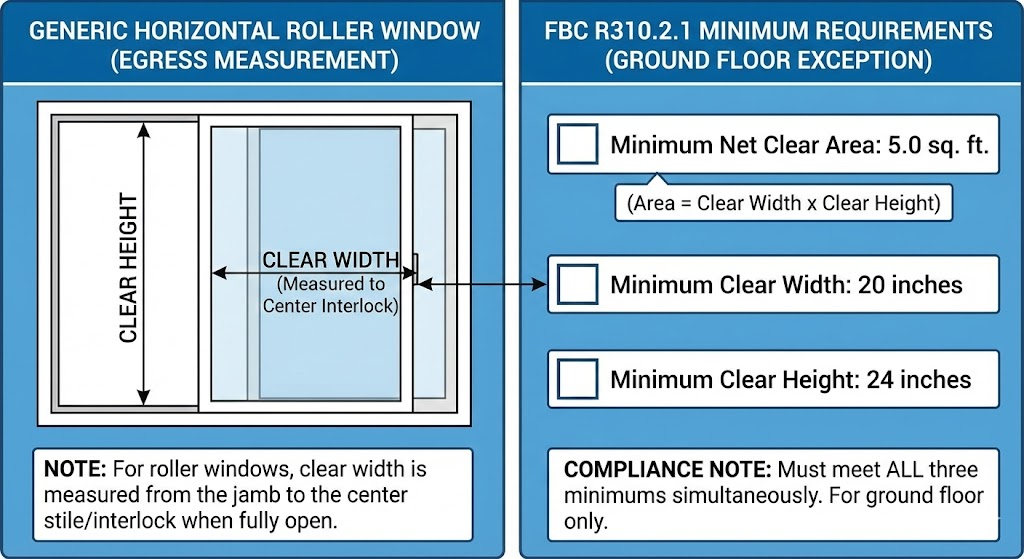
A Real-World Case Study: The Window That Barely Passed
We recently analyzed a project where a contractor flagged a ground-floor horizontal roller window as non-compliant because it didn’t meet the 5.7 sq. ft. standard.
The window unit’s frame size was roughly 53″ x 38″. On paper, it looked too small to many installers.
However, when we demanded the exact, on-site measurements of the clear opening (the actual open space when slid fully open), the numbers told a different story:
- Measured Clear Width: 22 – 13/16″(22.81″)
- Measured Clear Height: 32.25″
We ran the math against the ground-floor requirement:
22.81 x 32.25 = 735.6 sq. inches
To convert square inches to square feet, divide by 144:
735.6 / 144 =5.11 sq. ft.
The Verdict: Because this window was on the ground floor, the requirement was only 5.0 sq. ft. The window passed by a mere 0.11 sq. ft. (about 15 square inches).
If this window had been on the second floor, it would have failed. But by knowing the code exception and measuring precisely, the project was saved from a costly revision.
Beyond Egress: Don’t Forget Energy Code
While egress is vital for safety, it is only half the battle in Florida compliance.
When selecting windows, the U-factor, SHGC (Solar Heat Gain Coefficient), and glazing specs are critical for passing energy calculations, but egress is where projects often get red-tagged during final inspection because it involves physical measurements on-site.
Ensure your engineering team is looking at both the thermal performance for Florida’s rigorous energy code and the physical dimensions for life safety.
Summary Checklist for Florida Egress
Before ordering windows for a bedroom renovation, verify these three things simultaneously:
- ✅ Net Clear Opening Area: Is it 5.7 sq. ft. (upper floors) or 5.0 sq. ft. (ground floor)?
- ✅ Minimum Clear Width: Is the opening at least 20 inches wide?
- ✅ Minimum Clear Height: Is the opening at least 24 inches high?
Note: You must meet all three. For example, a window that is 20″ wide x 24″ high only equals 3.3 sq. ft., so it would fail, even though it meets the minimum width and height dimensions.
