Shipping container homes, engineered for real wind loads — not catalog assumptions.
April 21, 2026 · Enrique Lairet, PE
Shipping container homes, engineered for real wind loads — not catalog assumptions.
A shipping container house has a structural advantage most builds don't: a welded corten-steel frame with load-bearing corner castings rated for stacking nine containers high. But that advantage disappears the moment the foundation, anchoring, or cladding is designed to the wrong wind speed. This page walks through how to engineer a container home for coastal exposure — and how to pull the actual NOAA wind history for your exact site before drawings are stamped.
The structural case for a shipping container house.
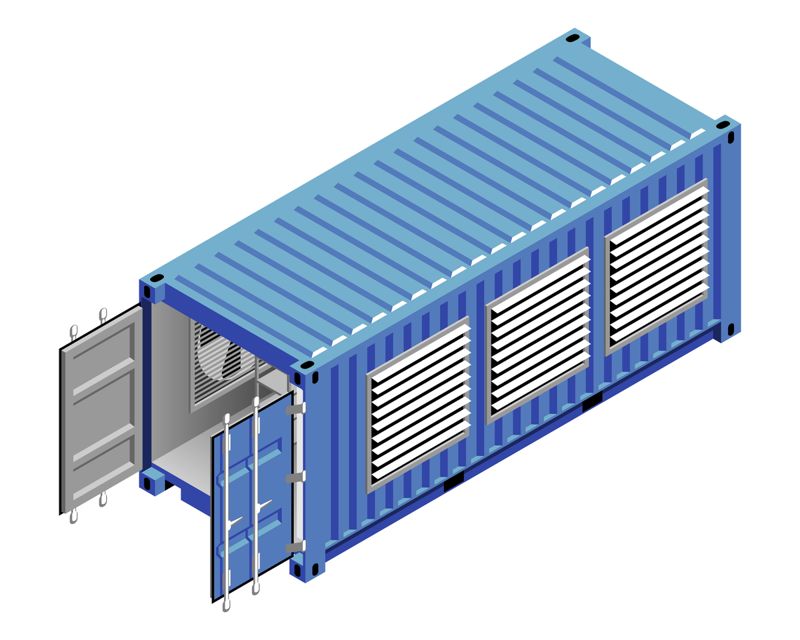
A standard ISO 1496 intermodal container is a fully-welded steel monocoque. The corner castings at each of its eight vertices are rated to transfer the entire stacked weight of eight more loaded containers above them — roughly 192,000 kg of vertical capacity per corner. The corrugated side walls are structural. The floor sits on a frame of 4-inch steel cross-members. It arrives already engineered; the question for a container home is what happens after you start cutting it.
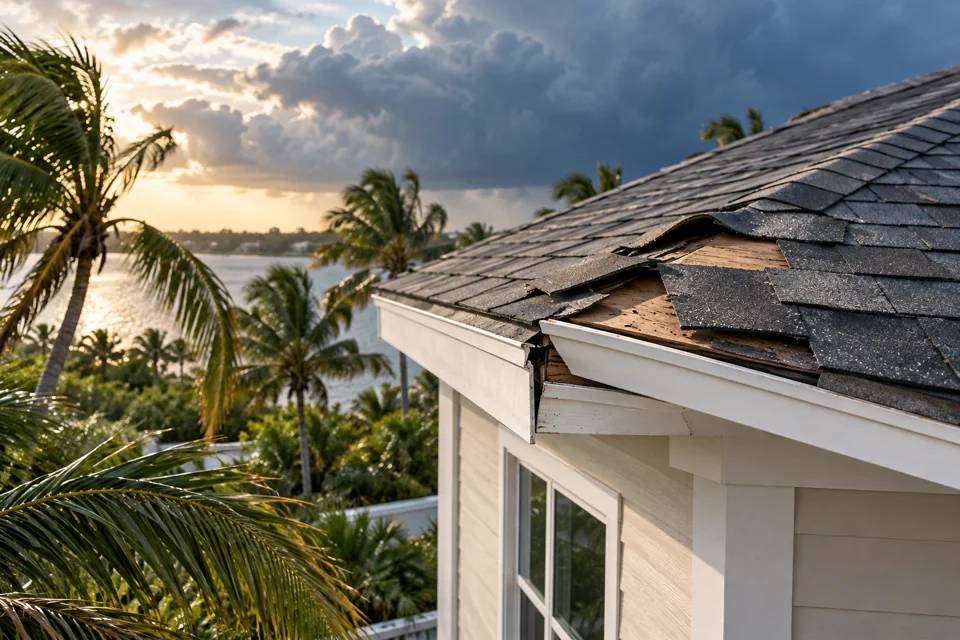
Every opening you cut — a door, a window, a section removed to join two containers side-by-side — removes load path. In a coastal or hurricane-zone build, that matters. Wind doesn't just push a structure sideways; it creates uplift, pulling the roof and walls outward as low-pressure vortices form along corners and eaves. A weathering steel box designed to be stacked is not automatically a box designed to resist being lifted. That is a design problem — and the inputs to that problem start with your site-specific wind speed.
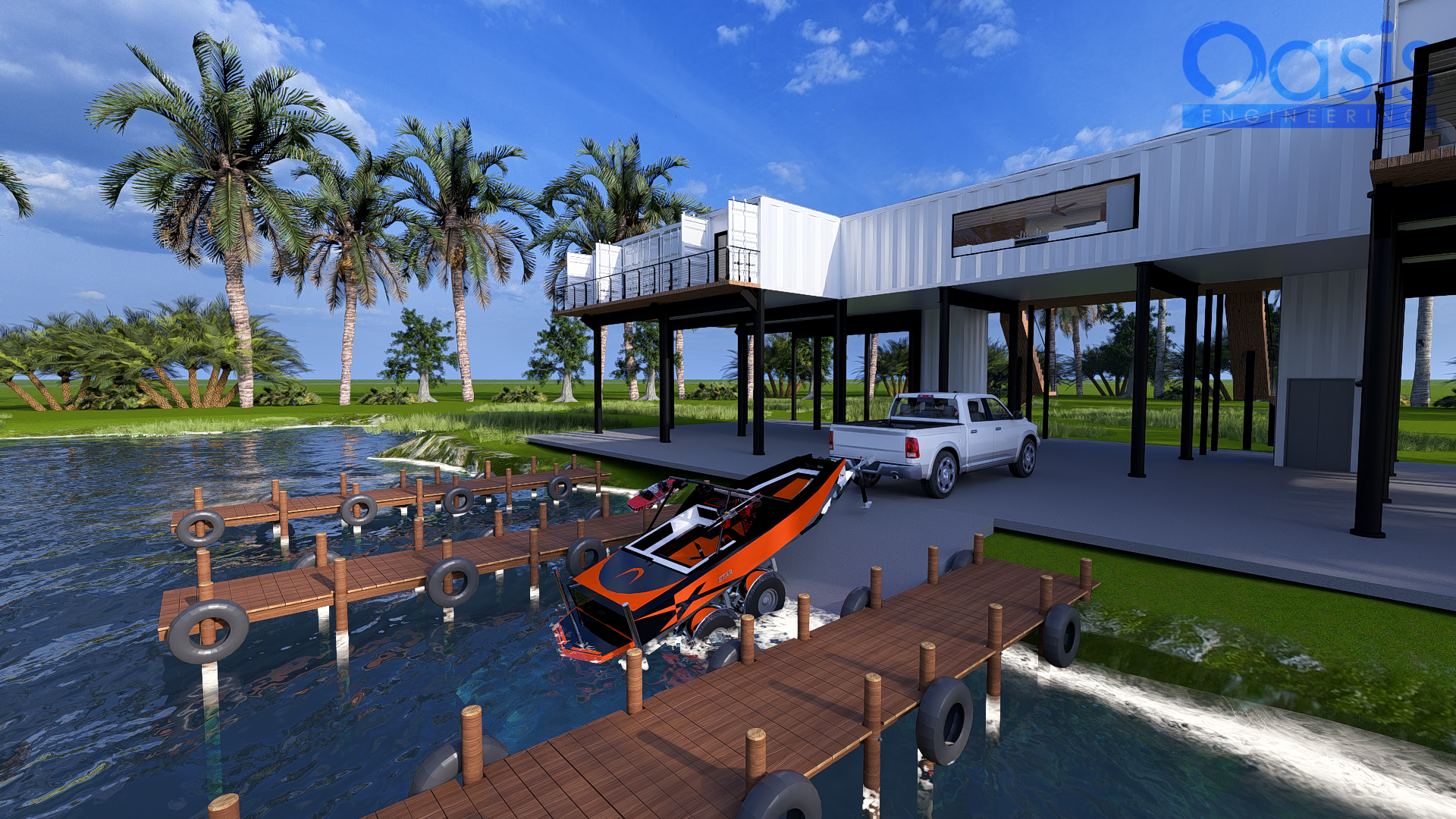
This guide covers how to think about wind load, foundation anchoring, exposure category, cladding, and verification for shipping container homes built in regions where hurricanes and severe thunderstorms are a design concern — the Florida Gulf and Atlantic coasts, coastal Texas, the Carolinas, coastal Georgia, and the hurricane-active areas of the northeast.
20' × 8' × 8'6" · ~2,300 kg tare
40' × 8' × 9'6" · ~3,900 kg tare
Rated vertical load per corner (ISO 1161)
Corrugated side walls are structural
ASCE 7 tells you the code speed. It doesn't tell you what actually hit your lot.
Two different questions. Both matter.
Container home design in a hurricane zone typically starts with ASCE 7 — the American Society of Civil Engineers standard that sets minimum wind loads for buildings. It gives you Vult, the ultimate design wind speed, as a function of geographic location, building risk category, and exposure category. For a Risk Category II residence in Miami-Dade, that number is north of 170 mph; in coastal North Carolina, ~150 mph; inland Florida, ~130–140 mph. Exposure D (coastal, open water) loads design pressures higher than Exposure C (open terrain) by roughly 20–30%.
Those numbers set the floor for how the container home must be anchored, how its penetrations must be reinforced, how its cladding and windows must be rated. But ASCE 7 is a code-minimum input — it tells you what to design for, not what actually happened at your address during the last storm. Those are two different engineering questions.
For pre-build design, you want the ASCE 7 code speed for your site, plus a sanity-check against the actual peak gusts that have been recorded near your property in the NOAA Storm Events Database. If the nearest ASOS station recorded a 148 mph gust in 2018, and your code minimum is 130 mph, that is a meaningful data point for the designer and the owner. It doesn't override the code — it informs the margin.
For post-storm documentation — insurance claim, permit reinspection, structural review — you need the opposite: the recorded conditions at your address on a specific date. That's the piece that's hardest to assemble by hand, and the piece StormProof™ is built for.
Approximate ASCE 7-22 Risk Category II Vult.
Code speeds for common container-home build regions. Confirm final values against current ASCE 7 and your local AHJ.
What actually has to be right on a shipping container home.
Eight considerations that every storm-country container build has to solve for.
Foundation & anchoring
Concrete pier, helical pile, or monolithic slab — tied to the four corner castings with engineered anchor bolts sized to the uplift load, not guesswork. This is the single most common point of failure.
Opening reinforcement
Every door, window, and side-cut removes structural wall. Requires welded steel header/sill reinforcement sized to restore the original load path. Don't skip this because the box "looks fine."
Roof / cladding uplift
If you add a pitched roof for rainshed, it becomes a sail. Must be rated to the code wind speed with proper hurricane straps. The box roof is usually fine as-is for drainage with a slight slope.
Exposure category
Coastal lots inside 600 ft of water are typically Exposure D — loads 20–30% higher than Exposure C. Get this wrong and every other calc is wrong.
Corrosion & coating
Corten stabilizes; it doesn't stop. Coastal salt air + field-cut edges = accelerated corrosion. Every cut needs paint, primer, and inspection schedule.
Insulation envelope
Steel box has zero thermal mass benefit and huge thermal bridging. Closed-cell spray foam interior or exterior rigid foam + rainscreen. Also resolves condensation on the inside of the wall.
Multi-container joining
Two or three containers side-by-side is where most engineering failures start. Cutting a shared wall = removing half the load path of each box. Requires structural steel moment frame to replace it.
Floor plane & subfloor
Original floor is marine plywood treated with pesticides. Most builds rip and replace with insulated subfloor. Check with your state on the original treatment before living on it.
Popular container home layouts and their engineering tradeoffs.
Rough square footage assumes a 40' High-Cube at 320 sqft gross.
Single 40' HC
~290 sqft net · 1 bedThe simplest build. Structurally cleanest — minimal cutting, corner load paths intact. Popular for tiny homes, ADUs, and off-grid builds. Easiest to pass wind-load review.
Dual 40' — side-by-side
~580 sqft net · 2 bedJoining at the long wall creates an open ~16' × 40' interior. The engineering ask: the removed shared wall has to be replaced with a welded steel moment frame. Most common "real house" layout.
Stacked two-story
~580 sqft net · 2 storyCorner castings love vertical load — this is what containers were built for. Stacking is structurally elegant. Complexity moves to stair access, second-story egress, and lateral bracing.
Triple-wide
~870 sqft net · 3 bedThree 40' containers with two shared walls removed = a ~24' × 40' great room. Each removed wall needs its own replacement moment frame. Engineering cost climbs quickly.
Courtyard / U-plan
~600 sqft netTwo separated containers with a roofed or open courtyard between. Structural simplicity (no shared wall cuts) — but the connecting roof is a separate wind-load problem and often under-engineered.
Cantilever / L-plan
variableOne container cantilevered over another for architectural effect. Possible — containers can support it — but the lateral moments in a hurricane are significant. Not a DIY geometry.
How StormProof™ fits into a container home project.
Two use cases — pre-build and post-storm — on the same underlying data.
Pre-build · site wind history
Before drawings are stamped, pull the recorded peak gust history for your exact lot across the last decade. Useful alongside the ASCE 7 code speed as a sanity check and for the owner to understand real exposure.
During construction · exposure verification
Confirm whether your lot is actually Exposure C or Exposure D under current NOAA topography and vegetation records. A 20–30% pressure delta rides on this classification.
What container home owners actually run into.
Permits. Every county now has a framework for permitting container homes, but the depth of scrutiny varies wildly. Florida counties under the Florida Building Code will ask for a full structural stamp by a licensed engineer, with wind-load calculations to the current ASCE 7 edition. Rural counties may accept a simpler submission. Either way, the single fastest way to derail a container home permit is to show up without structural engineering calcs that match the site-specific wind zone. The box being "steel" is not an argument.
Cost. The container itself is the cheap part — a one-trip 40' High-Cube is roughly $5–8k delivered to most of the east coast; used "cargo worthy" is lower. The expensive parts are the foundation, the insulation envelope, the openings, the roof (if pitched), the electrical and plumbing fit-out, and — where code requires it — the structural engineering. A fully permitted, finished, stormproof shipping container home in coastal Florida typically lands between $180–$280 per square foot, which is in the same range as conventional stick-built once everything is totaled. The win is usually speed, repeatability, and thermal performance — not raw dollars.
Timeline. Container acquisition: 2–6 weeks. Site prep and foundation: 4–8 weeks. Modifications (cutting, welding, reinforcement): 3–6 weeks at a qualified fabricator. Fit-out (insulation, drywall, MEP, finish): 8–14 weeks. Permitting can run in parallel or sequentially depending on jurisdiction. Total: ~6–9 months for a well-run single-container or dual-container build.
Insurance. Because container homes are unconventional, insurers will usually ask for the structural engineer's wind-load calcs and exposure category. Having the site's recorded wind history alongside the ASCE 7 code number helps close the quote faster. After a storm, the same data supports documentation.
The questions that come up most on a container home build.
More depth, by topic.
Explore the container home literature
- Shipping container architecture (overview)
- Intermodal container & ISO 1496 specs
- Corten / weathering steel chemistry
- Helical pile foundations
- ASCE 7 wind-load standard
- Florida Building Code
- NWS ASOS wind-station network
- NOAA Storm Events Database
- National Hurricane Center
- Hurricane Ian (2022) — SW Florida reference
- Hurricane Michael (2018) — FL Panhandle reference
- Hurricane Andrew (1992) — South Florida baseline
Research wind history for a specific property.
Sister utilities that pull NOAA weather records for any U.S. address.
Pull the real wind history for your container home site.
Address-specific peak gusts, rainfall, NWS warnings, and NEXRAD radar context — sourced from NOAA and packaged as a cited PDF in minutes. Use it pre-build to sanity-check your design wind speed, or post-storm to document what hit the property.
Related