...

wind calculations

The 5.7 Sq. Ft. Myth: Florida Egress Window Requirements Clarified (FBC R310)

The 5.7 Sq. Ft. Myth: Florida Egress Window Requirements Clarified (FBC R310) It’s a panic-inducing scenario common in Florida renovations: The new impact windows have arrived, or perhaps they are already installed, and your contractor or building inspector drops a bombshell: “This bedroom window is too small. It doesn’t meet the 5.7 square foot egress requirement.” Before you panic and order a larger, more expensive custom window, you need to know the actual rules. There is a widespread misconception in the industry that every sleeping room window must meet the 5.7 sq. ft. rule. According to the Florida Building Code (FBC) Section R310, that is often incorrect. If you are dealing with a bedroom on the ground floor, the rules change in your favor. Here is an engineering breakdown of the most misunderstood rule in residential window replacements. The Rule vs. The Exception (FBC R310.2.1) The Florida Building Code dictates that every sleeping room must have at least one operable emergency escape and rescue opening (egress window). This ensures occupants can escape, and firefighters with bulky gear can enter, during a fire. The confusion stems from FBC Residential Section R310.2.1, which contains two distinct standards based on the location of the room. The General Rule (Second Story and Above) For bedrooms located on the second floor, third floor, or higher, the Net Clear Opening must be at least 5.7 square feet. Why 5.7? This size accommodates a firefighter entering through the window from a ladder. The Grade-Floor Exception (Ground Floor) If the bedroom is on the “grade-floor” (ground level), the code grants an exception. Because firefighters have easier access from the ground without a ladder, the requirement is lowered. For ground-floor bedrooms, the minimum Net Clear Opening is only 5.0 square feet. That differential of 0.7 sq. ft. (roughly 100 square inches) is massive when dealing with standard window sizes. The “Gotcha”: It’s Not About Frame Size The second biggest mistake homeowners and even some professionals make is confusing the window’s frame dimensions or the glass size (daylight opening) with the Net Clear Opening. The code doesn’t care how big the window unit is; it cares about the actual hole created when you open the window fully. Measuring Horizontal Rollers Impact horizontal roller windows are notorious for failing egress calculations because their heavy-duty frames and interlocks eat up valuable space. When you slide a horizontal roller open, you cannot just measure half the width. You must measure from the edge of the jamb to the center interlock stile that remains in the middle of the window. You lose several inches of “clear width” right there. A Real-World Case Study: The Window That Barely Passed We recently analyzed a project where a contractor flagged a ground-floor horizontal roller window as non-compliant because it didn’t meet the 5.7 sq. ft. standard. The window unit’s frame size was roughly 53″ x 38″. On paper, it looked too small to many installers. However, when we demanded the exact, on-site measurements of the clear opening (the actual open space when slid fully open), the numbers told a different story: We ran the math against the ground-floor requirement: 22.81 x 32.25 = 735.6 sq. inches To convert square inches to square feet, divide by 144: 735.6 / 144 =5.11 sq. ft. The Verdict: Because this window was on the ground floor, the requirement was only 5.0 sq. ft. The window passed by a mere 0.11 sq. ft. (about 15 square inches). If this window had been on the second floor, it would have failed. But by knowing the code exception and measuring precisely, the project was saved from a costly revision. Beyond Egress: Don’t Forget Energy Code While egress is vital for safety, it is only half the battle in Florida compliance. When selecting windows, the U-factor, SHGC (Solar Heat Gain Coefficient), and glazing specs are critical for passing energy calculations, but egress is where projects often get red-tagged during final inspection because it involves physical measurements on-site. Ensure your engineering team is looking at both the thermal performance for Florida’s rigorous energy code and the physical dimensions for life safety. Summary Checklist for Florida Egress Before ordering windows for a bedroom renovation, verify these three things simultaneously: Note: You must meet all three. For example, a window that is 20″ wide x 24″ high only equals 3.3 sq. ft., so it would fail, even though it meets the minimum width and height dimensions.

The 5.7 Sq. Ft. Myth: Florida Egress Window Requirements Clarified (FBC R310) Read More »

Boulder Wind Engineering

Navigating Boulder’s Building Codes: A Complete Engineering Guide for Your Project

Navigating Boulder’s Building Codes: A Complete Engineering Guide for Your Project Building in Boulder, Colorado, offers the rare opportunity to create structures amidst one of the nation’s most stunning natural landscapes. This allure, however, is matched by a unique set of challenges. The region’s progressive ethos is reflected in a complex and forward-thinking regulatory environment, while its position at the foot of the Rocky Mountains subjects projects to some of the most demanding environmental forces in the country, chief among them being severe wind events. For architects, builders, and homeowners, navigating the building permit and design process can be a daunting task, filled with jurisdictional nuances, hyper-specific code amendments, and stringent structural requirements. A misstep in this landscape can lead to costly project delays, extensive redesigns, or, in the worst-case scenario, structural failure. This guide serves as a comprehensive roadmap to demystify this process, highlighting the critical engineering requirements necessary for project approval in the Boulder area. Understanding these rules—especially those related to wind engineering—is not merely a matter of compliance; it is fundamental to ensuring the long-term safety, resilience, and value of any structure built on the Front Range. By delving into the specifics of local codes, this report provides a clear path to a successful and secure build. The Lay of the Land: Understanding Boulder’s Jurisdictional Labyrinth The most critical and foundational concept for any Boulder-area project is that the rules are not monolithic. A common and costly error is applying the wrong set of codes, an issue that can be avoided by first understanding the local regulatory geography. City vs. County – A Tale of Two Building Departments Any construction project in the Boulder area is governed by one of two distinct entities: the City of Boulder Planning & Development Services for projects within city limits, or the Boulder County Community Planning & Permitting Department for projects in unincorporated areas.1 These are separate organizations with their own administrative staff, websites, online application portals, and, most importantly, their own unique building code amendments.3 The County’s jurisdiction explicitly covers unincorporated Boulder County, while municipalities like the City of Boulder adopt and enforce their own codes.2 The failure to correctly identify a project’s governing jurisdiction is the most fundamental error a project team can make, with ripple effects that can invalidate an entire set of construction documents. For example, the City of Boulder specifies design wind speeds in a table within its municipal code, differentiating between properties east and west of Broadway.4 In contrast, Boulder County uses a detailed wind speed map that provides site-specific values.5 Using the wrong source for this single critical parameter would render all subsequent structural calculations incorrect. Therefore, the first step to compliance, before any other planning or design work begins, must be a definitive address check to confirm which building department has authority over the property. A Moving Target: Keeping Pace with Code Adoption Cycles Building codes are not static; they evolve to incorporate new research, materials, and safety standards. Both the City and County periodically adopt newer versions of the International Codes—such as the International Building Code (IBC) and International Residential Code (IRC)—along with a suite of local amendments. The design requirements for any given project are determined by its permit application submittal date.6 This creates a dynamic regulatory environment. As of 2025, both jurisdictions have undergone recent, significant updates: The staggered and recent nature of these code adoption cycles creates a significant “compliance gap” risk, particularly for projects with long design and planning phases. A complex custom home or commercial building may have a design phase lasting many months. A project team that begins work assuming the applicability of a current code could find its plans non-compliant if the permit application is delayed past the effective date for a new code cycle. This would necessitate significant and costly revisions to structural, energy, and life-safety systems to meet the newer, often more stringent, standards. Proactive engagement with these timelines is essential to future-proof a design and avoid unforeseen expenses. The Force of Nature: Mastering Boulder’s Wind Engineering Requirements Boulder’s location at the transition between the Great Plains and the Rocky Mountains creates unique meteorological conditions, including powerful downslope windstorms. In recognition of this, local codes designate the area as a “Special Wind Region,” making robust wind engineering a primary driver of structural design and a non-negotiable aspect of public safety.8 The Ultimate Design Wind Speed (Vult​): A Tale of Two Maps The foundation of any wind load calculation is the ultimate design wind speed, or Vult​. This value is determined differently depending on the project’s jurisdiction. The following table summarizes the primary wind speed criteria for the area. Jurisdiction Risk Category I Risk Category II Risk Category III & IV City of Boulder – East of Broadway 140 mph 150 mph 160 mph City of Boulder – West of Broadway 155 mph 165 mph 175 mph Unincorporated Boulder County Refer to Map Refer to Map Refer to Map Data derived from Boulder Revised Code 10-5-2 4 and Boulder County Wind Speed Map.5 The ASCE 7 Standard and the Topographic Factor (Kzt​) Anomaly The American Society of Civil Engineers’ standard, Minimum Design Loads and Associated Criteria for Buildings and Other Structures (ASCE 7), is the nationally recognized methodology for calculating wind pressures.8 A key component of this standard is the Topographic Factor, Kzt​. This factor is a multiplier used in the velocity pressure equation, $q_z = 0.00256 K_z K_{zt} K_e V^2$, that accounts for the acceleration of wind as it flows over abrupt changes in terrain like hills, ridges, and escarpments.11 Per ASCE 7, this factor must be considered when a structure is located in the upper half of a hill or near a crest, and the terrain meets specific geometric criteria, such as a height-to-length ratio ( H/Lh​) of at least 0.2.11 The formula for Kzt​ is $K_{zt} = (1+K_1K_2K_3)^2$.12 Given Boulder’s hilly and mountainous terrain, the application of Kzt​ would seem universal. However, a critical and nuanced distinction exists between the

Navigating Boulder’s Building Codes: A Complete Engineering Guide for Your Project Read More »

🏛️ New Florida Law Speeds Up Permits: What HB 683 & HB 1035 Mean for Engineer Letters and Wind Calculations (Effective July 1, 2025)

🏛️ New Florida Law Speeds Up Permits: What HB 683 & HB 1035 Mean for Engineer Letters and Wind Calculations (Effective July 1, 2025) Florida contractors, engineers, and homeowners just got a major permitting win. As of July 1, 2025, two new laws—HB 683 and HB 1035—are officially in effect, transforming how building permits are reviewed, processed, and enforced statewide. Whether you’re pulling permits for a container home, a residential addition, or submitting a signed engineer letter for wind calculations, this guide explains what’s changed and how it affects you. ✅ Summary of New Florida Permitting Law Changes 1. Contracts No Longer Required with Permit Applications Local jurisdictions cannot require pricing, contracts, or contingency terms to be included in a permit application. This is critical for: Protecting proprietary contractor and owner agreements Reducing administrative burden on engineer-submitted packages Tip: When submitting an engineer letter or wind load analysis, make sure your documents are code-compliant—but leave out private contract details unless specifically required by statute. 2. Mandatory Permit Review Timelines Florida now has fixed deadlines based on project size: Use Case: If you’re submitting engineered wind calcs for a rooftop solar install or HVHZ compliance letters, the reviewing agency must now respond faster—or risk triggering automatic approvals or legal obligations. 3. Engineer Letters and Wind Calculations Get Fast-Tracked For low-risk, single-trade scopes like: Solar panel installation Residential windows and doors Alarm systems or plumbing You may now use private providers, third-party inspectors, or virtual inspections to satisfy permitting and compliance faster—particularly helpful when paired with: Wind calculation letters Structural load analysis HVHZ engineer compliance documentation ✍️ How This Impacts Engineer Letters If you’re an engineer or contractor submitting: Structural letters for code compliance Wind calculation packages HVHZ or ASCE 7 design documentation These laws directly improve turnaround times, reduce government red tape, and protect your deliverables from being delayed over unrelated paperwork. ⚠️ Change Orders Are Now Enforceable Local agencies must respond to change order pricing within 30 days. If they don’t—and fail to justify a denial in writing—they may be held financially responsible for: Material and labor costs Overhead and schedule impact This gives engineers and GCs stronger leverage when conditions change mid-project and new documentation (such as revised plans or letters) must be submitted. 📌 Final Thoughts The July 1, 2025 changes to Florida’s permitting laws are a major win for professionals who rely on: Accurate engineer letters for code compliance Timely wind calculations and structural load designs Faster permit approvals for residential and light commercial construction Need an Engineer Letter or Wind Calculation for Florida Permits? At Oasis Engineering, we provide: Stamped engineer letters for permitting across all Florida counties ASCE 7-16 compliant wind load calculations for roofs, walls, and fenestration Fast turnarounds and HVHZ-ready reports Visit https://oasisengineering.com/engineer-letters or https://windcalculations.com to get started.

🏛️ New Florida Law Speeds Up Permits: What HB 683 & HB 1035 Mean for Engineer Letters and Wind Calculations (Effective July 1, 2025) Read More »

Underlayment Installation Over Existing Self-Adhered Roofing

🏠 Underlayment Installation Over Existing Self-Adhered Roofing – What Happens When It Can’t Be Removed?

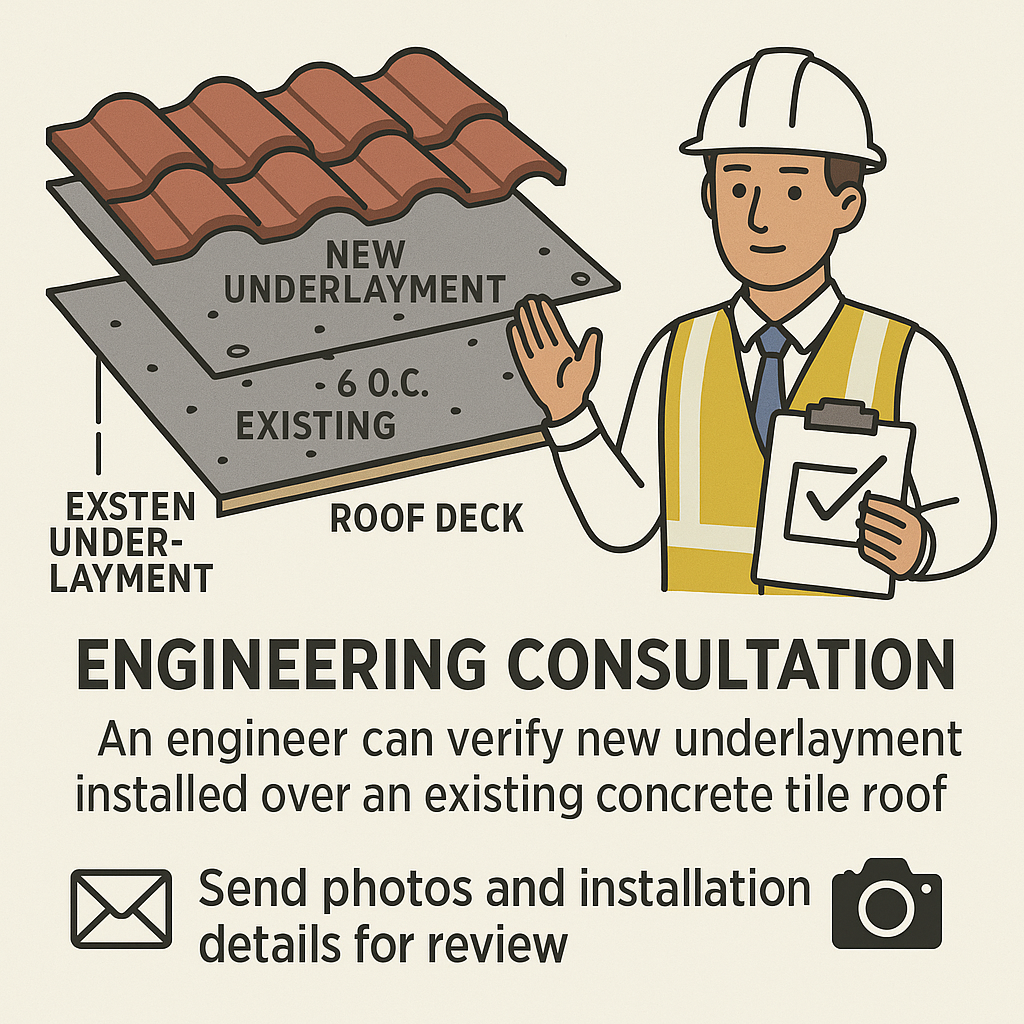
🏠 Underlayment Installation Over Existing Self-Adhered Roofing – What Happens When It Can’t Be Removed? Roofers and homeowners often face a tricky situation during re-roof projects involving self-adhered underlayments—like Polystick TU Plus—that are nearly impossible to remove. So what happens when the original underlayment can’t be taken off? Can a new layer be applied on top? Will inspectors approve it? At Oasis Engineering, we recently helped a client resolve this exact issue during a concrete tile roof replacement. Below, we break down the problem, code considerations, and how our Engineering Letter of Certification service can help you move forward—even if inspections were missed or the dry-in stage has already been completed. ❗ The Problem: Existing Polystick TU Plus Underlayment Wouldn’t Come Off During tear-off, the roofing crew found the existing underlayment (Polystick TU Plus) was fully adhered to the plywood decking. It was bonded so strongly that removal risked damaging the structural deck. To avoid delay, the crew: This created a two-ply system—but raised concerns when it came time for inspection. 🛑 Why Inspectors Flag This Most roofing approvals assume direct application of the underlayment to bare wood decking. Overlaying one layer over another isn’t a standard install in product documentation—so inspectors may hesitate to approve it without additional engineering justification. If the dry-in was completed without calling for inspection—or if the tile has already been installed—some jurisdictions may require a certified engineering letter to verify that the installation still meets Florida Building Code (FBC) requirements. ✅ How We Help: Engineering Letter for Dry-In Approval At Oasis Engineering, we provide certified engineering consultation and dry-in letters for cases just like this. Our process includes: This allows homeowners and contractors to pass inspection, even when conditions on site vary from standard installation manuals. 💬 Common Scenarios Where This Applies 📩 Need Help? Here’s How to Start If you’re dealing with a similar situation, we can help. Here’s what to do: Send it all to us via our form:👉 Submit your roofing request here Or reach out directly via email for urgent help. 🧠 Final Word Overlaying underlayment isn’t ideal—but it can be code-compliant when done correctly and with the right engineering review. Don’t let an inspection delay derail your roofing project. With Oasis Engineering, you get: Let us help you close that permit and move forward with confidence.

🏠 Underlayment Installation Over Existing Self-Adhered Roofing – What Happens When It Can’t Be Removed? Read More »

Eng Letter FAQ

Engineer Certification Letters — Common Questions | Oasis Engineering

What Is an Engineer Certification Letter? An engineer certification letter is an official document prepared by a licensed professional engineer (PE) that verifies the structural condition, code compliance, or safety of a specific element of your property. These letters are often required by building departments, insurance companies, lenders, or during real estate transactions. At Oasis Engineering, we specialize in providing engineer letters to help homeowners, builders, and developers resolve permit issues, document repairs, or meet state and local code requirements. Common Engineer Letters We Provide: ✅ Engineer Letter for Permit Closure If you’ve completed work without final inspections or your permit remains open, most jurisdictions require an engineer letter to close the permit. We inspect the work and, if compliant, issue a letter stating it meets applicable codes. ✅ Engineer Affidavit for Unpermitted Work Unpermitted work can delay property sales, refinancing, or trigger code enforcement. Our licensed engineers can inspect the work, assess code compliance, and provide an affidavit to help legalize the situation and support retroactive permits. ✅ Structural Engineer Letter for Code Compliance We routinely issue structural letters confirming that repairs, additions, or modifications meet applicable building codes—whether for walls, framing, foundations, or general structural safety. ✅ Foundation Certification Letters For manufactured or mobile homes, FHA loans, HUD programs, or county requirements often mandate a foundation certification. We provide engineer letters confirming the foundation meets permanent or regulatory requirements nationwide. ✅ Truss, Roof, or Structural Repair Letters Roof certifications and truss repair engineer letters are common after storm damage, leaks, or alterations. We inspect and certify repairs or existing conditions for insurance, real estate, or compliance purposes. ✅ Engineer Letters for Roofing In-Progress Inspections This letters can officially verify that the roofing work meets all required standards, serving as an acceptable substitute for the missing permit in-progress inspections from the City or County. When Do You Need an Engineer Letter? ☑ Permit closure for completed but uninspected work☑ Buying or selling a property with unpermitted improvements☑ Structural changes, repairs, or safety concerns☑ Manufactured/mobile home foundation certifications (HUD/FHA compliance)☑ Insurance claims after storm or accident damage☑ Meeting city or county code requirements If you’re unsure, we’re happy to review your situation. Can You Provide Engineer Letters Remotely? Yes—we offer remote or virtual engineer letters when allowed by code and based on documentation, photos, or site videos. For certain projects, especially when ample documentation, data, plans or reports are available, remote service saves time and money. For more complex or structural issues, an on-site inspection by our engineering team may be required. We’ll guide you through the best option. State-Specific Support: Florida Engineer Letter Requirements We are highly experienced with Florida’s permitting, storm damage assessments, and engineer affidavit needs. Whether you’re in Pasco, Tampa, or statewide, we understand Florida Building Code (FBC) and High-Velocity Hurricane Zone (HVHZ) requirements. Texas, Arizona, and Nationwide Engineer Letters Oasis Engineering supports Texas projects with foundation certifications, unpermitted work affidavits, and structural inspections. We are also licensed in multiple states, providing engineer certification letters for projects across the country. How Long Does It Take? Typical turnaround times vary by project type and location: ✔ Virtual/remote letters: 2-5 business days✔ On-site inspections and letters: 5-10 business days✔ Expedited options may be available—ask us! Why Choose Oasis Engineering? Need Help with Permits, Inspections, or Unpermitted Work? Whether you need a foundation certification, unpermitted work affidavit, storm damage assessment, or general structural engineer letter—we’re here to help. Contact Oasis Engineering today to resolve your permit, compliance, or property certification needs.

Engineer Certification Letters — Common Questions | Oasis Engineering Read More »

Barton Memorial Park Cemetery Archway

Engineering Support for Historic Archway at Barton Memorial Park Cemetery – Preserving Culture Through Design

At Oasis Engineering, we take pride in providing engineering that does more than just meet code — we support projects that carry meaning, serve communities, and help preserve local history. One recent example is our work on the new entrance archway at Barton Memorial Park Cemetery in Boynton Beach, Florida. A Project with Purpose Barton Memorial Park Cemetery isn’t just a resting place — it’s a historic landmark. Once known as Cherry Hill, this cemetery is believed to be Boynton Beach’s first African-American burial ground, dating back to the early 1900s. Many of the people buried there were of Bahamian descent and among the city’s early pioneers. For years, the cemetery was neglected, especially during the construction of I-95 in the 1970s, but through community efforts and city recognition, it has since been restored and protected as part of the Boynton Beach Heritage Trail. When a new steel archway was proposed to honor the site’s history and create a welcoming entrance for visitors, we were honored to be part of the team that made it possible. Our Role: Structural Support for a Cultural Landmark We were brought into the project to provide structural engineering consulting and help ensure that this new feature would be safe, durable, and built to last. Our team delivered a comprehensive engineering package that included: More Than Metal and Concrete Yes — this project involved structural math, load paths, and code references. But more than that, it was about preserving legacy and creating something beautiful and respectful for the community. We believe that engineering should not only be functional — it should serve people. And when it’s done right, it helps elevate public spaces, honor stories, and protect the future by building on the past. Need structural engineering for your public art or monument project?We’d love to support your vision. Visit our Public Art & Monument Engineering page or contact us to learn more.

Engineering Support for Historic Archway at Barton Memorial Park Cemetery – Preserving Culture Through Design Read More »

Roof tile wind calculations engineer letter

How We Resolved Roofing Adhesive Approval Issues for Florida Compliance

Resolving Roofing Adhesive Approval Issues in Florida How We Resolved Roofing Adhesive Approval Issues for Florida Compliance At Oasis Engineering, we often encounter unique challenges in roofing installations where the exact product approval is not directly listed in current NOAs (Notice of Acceptance). Recently, we tackled an interesting case involving the Polyfoam PolyPro adhesive—now branded as ICP Polyset AH-160. The Challenge: Product Approval Discrepancy The project involved roofing tiles installed under NOA 22-0201.13, specifying ICP Polyset AH-160 adhesive. However, the actual adhesive used was labeled as Polyfoam PolyPro adhesive, referencing a different approval (NOA 15-0223.19). The confusion arose due to product rebranding following corporate acquisitions, notably Polyfoam Products Inc. being acquired by 3M, leading to product name changes. Engineering Analysis and Resolution To resolve the issue and comply with Section 553.842(5) of the Florida Statutes, we conducted a detailed site-specific engineering analysis according to the 2023 Florida Building Code (FBC). This analysis included: Wind Uplift Analysis per FBC Section 1609.6.3 (Rigid Tile) Evaluation for Ultimate Wind Speed of 175 MPH (Exposure Category C, Risk Category II) Verification that PolyPro adhesive provides equal or greater attachment resistance compared to the originally approved product. Findings and Approval Our analysis confirmed that the Polyfoam PolyPro adhesive (now ICP Polyset AH-160) provided sufficient uplift resistance, fully meeting or exceeding the NOA requirements. We successfully demonstrated that both adhesives are identical, despite the name change due to acquisition by 3M. Thus, ensuring compliance, safety, and performance under Florida’s strict building regulations. Need Assistance? If you face similar issues with roofing materials and approvals, our experienced engineers can provide site-specific engineered solutions to maintain your project’s compliance and safety. For specialized engineering reports and letters, visit our dedicated site: Engineer Letters. Additionally, for detailed wind load calculations, check out our service at Wind Calculations. Contact us today for expert assistance ensuring your project meets all applicable building code requirements.

How We Resolved Roofing Adhesive Approval Issues for Florida Compliance Read More »

Comprehensive Inspection Guide for Residential Remodeling Projects

Comprehensive Illustrated Inspection Guide – Oasis Engineering Oasis Engineering Visit our website Introduction Importance of Inspections in Residential Remodeling Inspections are a cornerstone of any residential remodeling project. They ensure that the work meets safety standards, complies with local building codes, and maintains structural integrity. For homeowners, inspections prevent future headaches like structural failures, electrical hazards, or plumbing leaks. For builders, they confirm quality and legal compliance. For inspectors, they safeguard public safety and enforce regulations. Skipping or failing an inspection can lead to costly delays, fines, or unsafe living conditions—making this process non-negotiable. Common Pitfalls and How to Avoid Them Scheduling Missteps: Calling for an inspection too early (before work is complete) or too late (delaying the next phase) can derail your timeline. Fix: Follow the construction sequence and confirm readiness with your contractor. Missing Documentation: Inspectors won’t proceed without permits, approved plans, or prior inspection reports. Fix: Keep a binder with all paperwork on-site. Ignoring Past Failures: Uncorrected issues from previous inspections guarantee repeat failures. Fix: Address all noted problems before rescheduling. How to Use This Guide This guide is your roadmap through the inspection process. It’s broken into: Master Checklist: A quick-reference list of all inspections by phase. Detailed Breakdowns: Step-by-step guidance for each inspection, with visuals and checklists. Pro Tips: Practical advice to keep things moving smoothly. Start with the Master Inspection Checklist to track progress. Dive into the Illustrated Step-by-Step Inspection Breakdown for specifics on each inspection. Use the illustrations (provided by you) to see what “right” looks like. Pro tip: Keep this guide handy on-site—digital or printed—for instant reference. Master Inspection Checklist This checklist organizes inspections by construction phase. Check off each as it’s completed, and ensure required documentation is ready before scheduling. Pre-Construction BLD-Pre-Construction InspectionDocumentation: Approved building plans, permits. Foundation BLD-Foundation/FooterDocumentation: Foundation plans, soil reports. BLD-Stem WallDocumentation: Foundation plans. BLD-Tie BeamDocumentation: Structural plans. BLD-Pilasters/Fill Cells/ColumnsDocumentation: Structural plans. BLD-On Grade Slab/Monolithic SlabDocumentation: Slab design plans. BLD-Driveway or Sidewalk Pre-PourDocumentation: Site plans. Framing BLD-Wall or Roof SheathingDocumentation: Framing plans. BLD-FramingDocumentation: Framing plans, truss engineering. Insulation & Energy Compliance BLD-Insulation-Ceilings/WallsDocumentation: Energy compliance forms. Mechanical, Electrical & Plumbing (MEP) ELE-Rough-InDocumentation: Electrical plans. ELE-Underground Rough-InDocumentation: Electrical plans. ELE-Pool BondingDocumentation: Pool electrical plans. MEC-Rough-InDocumentation: Mechanical plans. PLB-Rough-InDocumentation: Plumbing plans. PLB-Underground Rough-InDocumentation: Plumbing plans. PLB-SewerDocumentation: Sewer connection permits. PLB-Water ServiceDocumentation: Water service plans. PLB-Pressure TestDocumentation: Plumbing plans. PLB-Gas Rough-InDocumentation: Gas line plans. PLB-Tub SetDocumentation: Plumbing plans. Roofing ROF-Dry-in/MidDocumentation: Roofing plans. ROF-FinalDocumentation: Roofing plans. Final Inspections ELE-Electrical Power ReleaseDocumentation: Electrical plans. ELE-FinalDocumentation: Electrical plans. MEC-FinalDocumentation: Mechanical plans. PLB-FinalDocumentation: Plumbing plans. BLD-Final Grading-DrainageDocumentation: Grading plans. BLD-Site FinalDocumentation: Site plans. BLD-FinalDocumentation: All previous inspection reports. Specialty Inspections BLD-Pool Barrier/AlarmDocumentation: Pool safety plans. BLD-Pool Steel/Drain/BondDocumentation: Pool structural plans. BLD-Tree Replacement CheckDocumentation: Landscaping plans. BLD-Elevation Certificate CheckDocumentation: Elevation certificate. Illustrated Step-by-Step Inspection Breakdown Each inspection below includes its purpose, timing, common pitfalls, and a checklist. Illustrations are provided to show what to aim for or avoid. Site & Foundation Inspections BLD-Pre-Construction Inspection Purpose: Confirms the site is ready and all paperwork is in order before breaking ground. When to Schedule: Before any construction starts. Common Failures: No permits, unapproved plans, unclear property lines. Permits posted on-site. Approved plans available. Site staked and boundaries marked. BLD-Foundation/Footer Purpose: Verifies the foundation can support the structure. When to Schedule: After excavation and formwork, before concrete pour. Common Failures: Wrong dimensions, missing rebar, soggy or loose soil. Dimensions match plans. Rebar placed and tied correctly. Excavation clean and dry. Soil compacted per specs. Structural & Framing Inspections BLD-Framing Purpose: Ensures the skeleton of the house is sound and code-compliant. When to Schedule: After framing is up, before insulation or drywall. Common Failures: Skimpy nailing, no hurricane clips, hacked-up trusses. Studs, joists, and rafters spaced per plan. Nailing meets code (e.g., 16d nails, 6″ spacing). Hurricane clips installed where required. Trusses unmodified and per engineering. Insulation & Energy Compliance BLD-Insulation-Ceilings/Walls Purpose: Checks that insulation meets energy codes for efficiency. When to Schedule: After insulation, before drywall. Common Failures: Gaps, crushed batts, wrong R-value. R-value matches local code. No gaps or compression in insulation. Vapor barriers face the right direction. Mechanical, Electrical & Plumbing (MEP) Inspections ELE-Rough-In Purpose: Confirms electrical wiring is safe before it’s hidden. When to Schedule: After wiring, before insulation or drywall. Common Failures: Bad grounding, undersized wires, no junction boxes. Wires secured every 4.5 ft. Correct gauge for circuits (e.g., 12 AWG for 20A). Grounding complete and bonded. Junction boxes installed and accessible. PLB-Rough-In Purpose: Ensures plumbing is properly installed before concealment. When to Schedule: After pipes are in, before walls close up. Common Failures: Leaky joints, missing vents, no shutoff valves. Pipes sloped for drainage (1/4″ per ft). Vents extend through roof or tie into system. Shutoff valves installed per code. No leaks under test pressure. Roofing Inspections ROF-Dry-in/Mid Purpose: Verifies the roof is watertight before final layers. When to Schedule: After underlayment and flashing. Common Failures: Sloppy flashing, exposed nails, torn underlayment. Underlayment overlapped 2–4″ and nailed. Flashing seals all edges and penetrations. No exposed fasteners or damage. Specialty Inspections BLD-Pool Barrier/Alarm Purpose: Ensures pool safety features meet regulations. When to Schedule: Before filling the pool. Common Failures: Short fences, broken gates, no alarms. Fence 48″ high, gaps under 4″. Gates self-close and latch. Alarms on doors or pool surface work. Practical Guides & Pro Tips How to Schedule Inspections Efficiently Time It Right: Schedule as soon as work is done—don’t wait. Example: Call for framing once the last nail’s in. Team Up: Coordinate with your contractor to avoid surprises. Confirm they’ll be on-site. Batch It: If multiple systems (e.g., electrical and plumbing) are ready, schedule them together. Preparing for Re-inspections Fix Everything: Address every item on the failure report—half-measures won’t cut it. Prove It: Take photos of corrections and have them ready for the inspector. Act Fast: Reschedule ASAP to keep the project on track. Contractor vs. Homeowner Responsibilities Contractors: Handle scheduling, ensure code compliance, provide plans and permits. Homeowners: Double-check that inspections are booked and passed, keep records safe. Example Inspection Report

Comprehensive Inspection Guide for Residential Remodeling Projects Read More »

Hurricane Container Home Engineering

Designing Container Homes for Hurricane and Flood Resilience: Meeting ASCE 24 Standards

Designing Container Homes for Hurricane and Flood Resilience: Meeting ASCE 24 Standards As climate change continues to intensify the frequency and severity of hurricanes and flooding events, building resilient homes has become more crucial than ever. Container homes, known for their sustainability and affordability, can be engineered to withstand these natural disasters effectively. This article delves into the technical aspects of designing container homes above flood zones in compliance with ASCE 24 and hurricane codes, ensuring safety and structural integrity during extreme weather events. Understanding the Risks Hurricanes and Flooding Impact Hurricanes bring a combination of high winds, heavy rainfall, storm surges, and flooding. The structural design of homes in hurricane-prone areas must address: Regulatory Framework ASCE 24: Flood Resistant Design and Construction ASCE 24 is a standard referenced by the International Building Code (IBC) that provides minimum requirements for flood-resistant design and construction of structures in flood hazard areas. Hurricane Codes Local building codes in hurricane-prone regions, such as the Florida Building Code (FBC), incorporate stringent requirements to ensure structures can withstand hurricane-force winds and associated impacts. Designing Container Homes Above Flood Zones 1. Site Analysis and Planning 2. Elevation of the Structure 3. Structural Design Considerations Wind Load Resistance Flood Load Resistance 4. Material Selection 5. Debris Impact Protection 6. Access and Egress 7. Utility Systems Compliance with ASCE 24 Standards Key ASCE 24 Requirements for Residential Structures: Engineering Calculations Case Study: Resilient Container Home Design in Hurricane-Prone Area Project Overview: Lessons Learned from Past Hurricanes Historical hurricanes like Hurricane Helene (2024) and Hurricane Irma (2017) have highlighted the importance of resilient design: Conclusion Designing container homes to withstand hurricanes and flooding is both feasible and practical when adhering to ASCE 24 standards and local building codes. By incorporating elevated foundations, robust structural designs, and resilient materials, homeowners can enjoy the benefits of container living without compromising safety. At Oasis Engineering, our expertise lies in creating container homes that are not only sustainable and stylish but also engineered to stand strong against nature’s fiercest forces. We stay abreast of the latest codes and employ cutting-edge engineering practices to ensure your home is a safe haven, no matter the weather. Interested in building a hurricane and flood-resistant container home? Contact us to discuss your project and learn how we can help you create a resilient living space tailored to your needs. Stay safe, stay resilient.

Designing Container Homes for Hurricane and Flood Resilience: Meeting ASCE 24 Standards Read More »