Septic Tank Buoyancy Calculations: Why a Decades-Old Calc May Not Hold Your Tank Down
November 11, 2026 · Enrique Lairet, PE
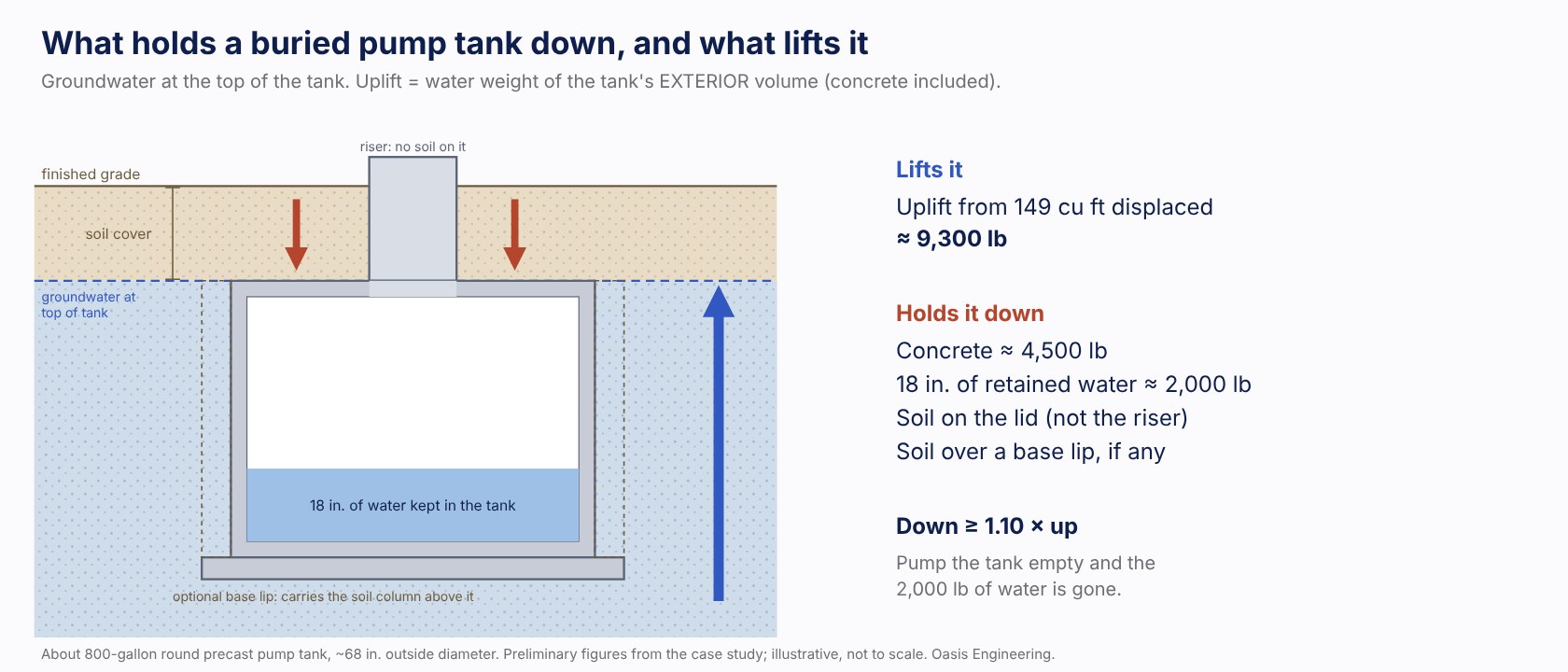
Most precast manufacturers have a buoyancy note on their tank drawings. It usually reads something like "18 inches of water must remain in the tank with ___ inches of soil on top." The number in that blank tells installers how deep to bury the tank so it doesn't float out of the ground when groundwater rises.
On many drawings, that number comes from a calculation done years ago, sometimes decades ago, on a mold that has since changed. We recently reviewed one of these for a precast manufacturer in Texas. What we found applies to a lot of tank drawings in use today.
The request
The manufacturer makes precast concrete septic and pump tanks. Two of its pump tanks, a roughly 800-gallon model and a roughly 500-gallon model, had been built on modified molds, and the buoyancy calculations needed redoing. They sent us the current drawings for both tanks and the stamped buoyancy calculation from 1998 for the earlier version of the larger tank.
Both are round tanks about 68 inches in outside diameter, with 2½-inch walls, a 3-inch bottom, and a 3 to 3½-inch lid with an access opening. The main difference is height. The drawings already carried the standard note requiring 18 inches of water to stay in the tank, with the soil cover left blank.
How does buoyancy work on a buried tank?
A buried tank behaves like a boat. When groundwater rises around it, the water pushes up with a force equal to the weight of the water the tank displaces. That is Archimedes' principle, and it applies to a septic tank in saturated soil the same way it applies to a hull.
Three things hold the tank down: its own concrete weight, the weight of any liquid kept inside it, and the weight of the soil on its lid. Engineers usually add a factor of safety, so the downward forces have to exceed the uplift by some margin. National Precast Concrete Association guidance commonly cites 1.10 where the structure is flooded to its top and only dead weight resists, and 1.25 in flood zones or where the groundwater level is not well defined.
The calculation itself is not complicated. The details that go into it are where tanks end up floating.
What was wrong with the older method?
The 1998 calculation figured the uplift from the tank's interior volume: how much water the tank holds. That is a common shortcut, and it is wrong.
A buried tank displaces its exterior volume, not its interior volume. The concrete walls, lid and bottom push water aside just as the hollow inside does. On the earlier tank, the interior volume was about 135 cubic feet and the exterior volume was about 171 cubic feet, so a calculation based on the interior leaves out roughly 21 percent of the uplift.
The older calculation also had no factor of safety, so it designed the tank to sit exactly at the point of floating. And it counted soil over the whole lid, including the access opening. A riser sits over that opening, and no soil rests there.
None of this was unusual for its time. Calculations like this one are on drawings across the industry, and most of those tanks never see the groundwater conditions that would expose the shortfall. The ones that do can float.
What do the numbers look like on the new molds?
To make sure we understood the 1998 method, we reproduced it first. With its original assumptions, our calculation gave essentially the same answer as the stamped letter: about 13 inches of cover with a 12-inch water bottom, and 21 inches with the tank empty. So the difference that follows comes from the method, not the arithmetic.
We then applied the same older method to the modified molds. It called for about 4 inches of soil cover on the larger tank with 18 inches of water kept inside, and no cover at all on the smaller one.
Then we ran it correctly: exterior volume, no soil credited over the access opening, a 1.10 factor of safety, and groundwater at the top of the tank. Preliminary results:
| Tank | Cover with 18 in. of water retained | Cover with the tank empty |
|---|---|---|
| Larger (about 800 gallons) | about 24 in. | about 37 in. |
| Smaller (about 500 gallons) | about 14 in. | about 27 in. |
That is a big jump from 4 inches, and the reason is simple. The larger tank displaces about 149 cubic feet, which produces roughly 9,300 pounds of uplift. The concrete weighs about 4,500 pounds. Everything between those two numbers has to come from retained water and soil.
The groundwater assumption matters too. If groundwater can reach finished grade, the soil on the lid is itself submerged and weighs much less. Under that condition the larger tank would need more than 40 inches of cover even with water retained.
Why does the empty-tank case deserve attention?
The "18 inches of water must remain" note does a lot of work. That water is worth about 2,000 pounds of hold-down on a tank this size. It only counts, though, if the pump-off float is actually set to keep it there.
A pump tank that is pumped out for service, or whose float is set lower than the drawing assumes, is an empty tank. If that happens after heavy rain in a high water table area, the empty-tank cover requirement is the one that matters. Manufacturers should know both numbers, and installers should understand which one their installation actually meets.
When isn't more soil the answer?
Deep cover brings its own problems. Every extra inch of soil adds load to a lid that may be only 3 inches thick, and a buoyancy calculation doesn't check whether the lid or tank can carry it. Before a cover depth goes on a drawing, it should be compared with the tank's rated maximum burial depth.
Risers are affected too. Texas rules require risers over the openings of septic tanks buried more than 12 inches below the surface, and for systems permitted on or after September 1, 2023, risers must extend to at least 2 inches above grade. A standard 6-inch riser won't reach grade on a tank buried 24 inches deep.
There is often a better option than more dirt: a lip on the bottom slab. A slab that projects a few inches beyond the walls picks up the weight of the soil column standing on it. For the larger tank at 12 inches of cover, a lip of about 3 inches all around made up the shortfall with water retained, and about 6 inches did it with the tank empty. If a mold is already being modified, adding a few inches to the base may cost much less than requiring installers to bury the tank twice as deep.
What should precast manufacturers check?
If your tank drawings carry a buoyancy note, it's worth asking:
- When was the calculation done, and for which version of the mold? Any change to height, wall, lid or openings changes the answer.
- Was the uplift based on the tank's exterior volume or its liquid capacity?
- What factor of safety was used, if any?
- Is soil credited over the access opening or riser?
- What groundwater level was assumed? Top of tank and finished grade give very different answers.
- Does the required cover fit within the tank's structural rating and the riser heights you supply?
- Is the retained-water level enforced by the pump controls, or only written on the drawing?
Texas regulations for on-site sewage facilities require precast tanks to meet the materials and structural design sections of ASTM C1227, and require a professional engineer to verify the manufacturer's compliance with that standard in writing. They set no flotation criterion for tanks, though. That means the factor of safety and the groundwater assumption are engineering decisions, and they should be stated clearly on the calculation so a reviewer can see what was assumed.
How we approach these calculations
We prepare buoyancy calculations for precast septic tanks, pump tanks, manholes, wet wells, vaults and other buried structures. Each calculation shows every input, assumption and step, so a reviewer can check it without calling us. We report results for both the empty and liquid-retained conditions, state the factor of safety and groundwater condition used, and size a base lip or other alternative when the required cover isn't practical.
If your tank drawings rely on an older buoyancy calculation, or you've modified a mold since the numbers were run, we can review it and tell you whether the published cover still holds. See the published rates and get an estimate, or send us the drawings.
Related: Pool flotation in flood zones.
Related